Climate Reality Hits Home — Ugandans Report Heatwaves, Droughts; Call for Government Action
Kampala, Uganda
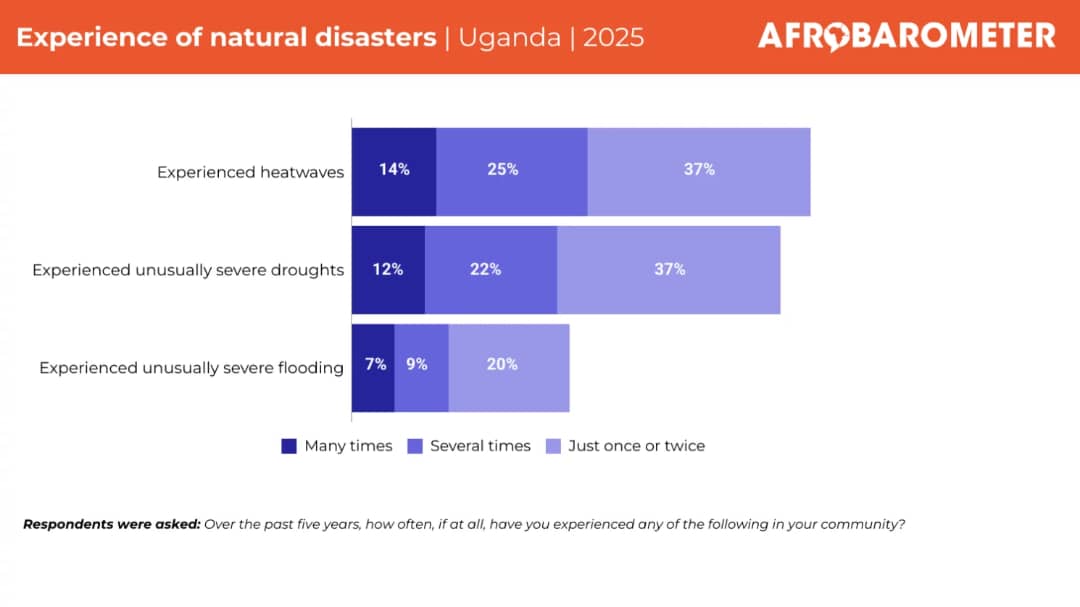
A new survey by Afrobarometer across Uganda paints a stark picture: over the past five years, about 76 % of Ugandans report having experienced heatwaves, and 71 % say they have suffered unusually severe droughts. At the same time, nearly two-thirds of respondents say they have heard about “climate change,” either in English or a local language. Awareness is particularly high among educated citizens and urban dwellers, with 84 % of degree-holders reporting familiarity with the concept.
Among those aware of climate change, 79 % attribute its cause primarily to human activity. More than half say climate change has made life either “somewhat worse” or “much worse,” citing disruptions to agriculture, water scarcity, food security, and unstable weather. In response, many Ugandans have already begun adapting: about 60 % of crop-growing households changed the kinds of crops they plant, and over half adjusted their diets.
Survey respondents also expressed clear expectations of government intervention: nearly half called for better early-warning systems ahead of extreme weather, and 47 % asked for emergency relief packages during disasters. Meanwhile, a majority said the government should step up efforts to protect the environment — even if it means limiting some economic activities like resource-extraction.
Why it matters
Climate change is no longer a distant threat in Uganda — it’s already affecting millions of lives, especially rural households reliant on agriculture, livestock and natural resources. As unpredictable rainfall, droughts and heatwaves become more frequent, food security, livelihoods and community resilience are under serious threat. The survey’s findings show not only the growing impact of climate stress, but also strong public awareness and demand for action.
For Uganda’s development trajectory — which heavily relies on agriculture, forestry and natural-resource livelihoods — climate shocks could undermine gains, deepen poverty, and generate displacement. How the government, private sector and communities respond to this challenge will shape Uganda’s resilience and long-term economic stability.
What to watch
Whether national and local governments act on public demand by strengthening climate policy, early-warning systems, disaster-relief mechanisms and sustainable land-use regulations. If adaptation measures become more widespread: drought-resistant crops, water-management systems, climate-smart agriculture, and environmental conservation. Whether public awareness campaigns expand — especially in rural areas — to educate citizens on climate risks and coping strategies. And how cooperation with international partners and climate-finance bodies will support Uganda’s transition toward greater climate resilience.